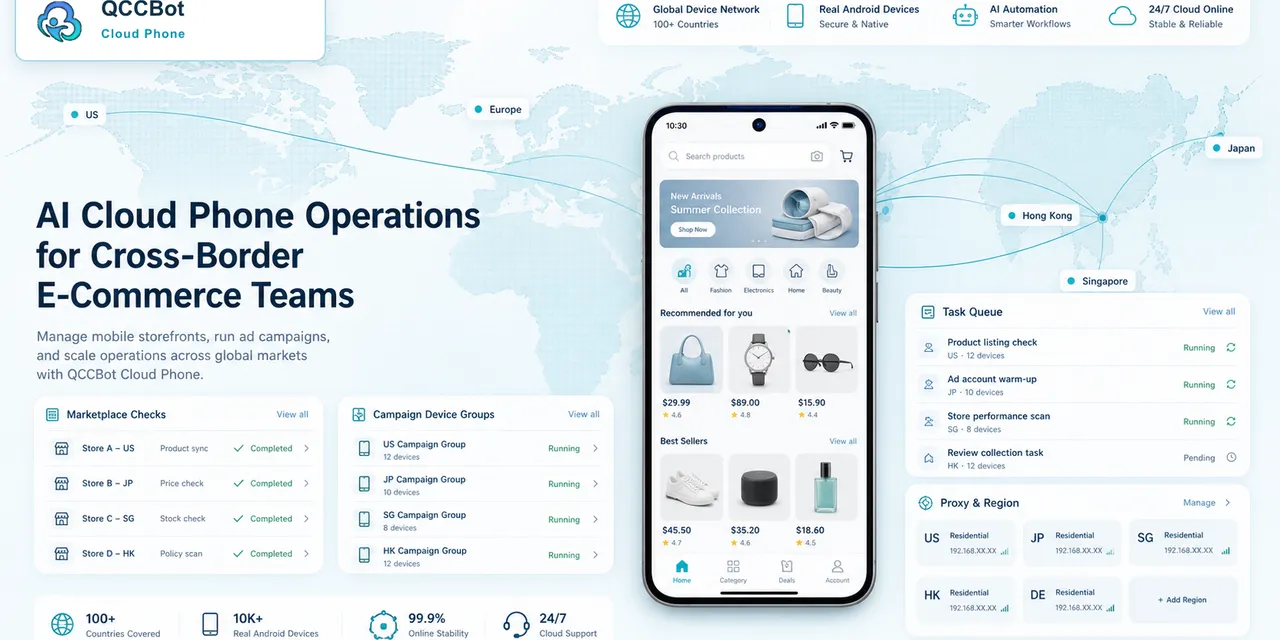
Cross-border teams do a lot of work inside mobile apps.
They check store apps. They review social accounts. They upload content. They look at messages. They test what users in different markets see. They confirm whether accounts are still active.
The work is not always complex. The problem is that it is scattered across many accounts, regions, apps, and devices.
The daily mobile work nobody wants to track manually
A cross-border team may need to check:
- US market accounts;
- Japan market accounts;
- Southeast Asia accounts;
- store app notifications;
- social app publishing status;
- message or comment alerts;
- content upload results;
- app loading and region display.
Each task may only take a few minutes. But together, they create a daily inspection workload.
Why physical phones become difficult
Physical phones are easy to understand, but hard to manage at scale.
Problems include:
- devices are in different locations;
- accounts are mixed across phones;
- people forget which phone belongs to which task;
- screenshots and results are hard to organize;
- checking many phones takes too much time;
- exceptions are discovered late.
Cloud phones solve part of this by giving teams remote Android environments. But cloud phones still need structure.
Start with groups, not scripts
Before writing scripts, define the groups.
Useful groups may include:
- US store check group;
- Japan social account group;
- Southeast Asia content upload group;
- daily inspection group;
- account abnormal group;
- new workflow testing group.
Once groups are clear, scripts and tasks become easier to assign.
Design checks around decisions
A daily check should produce decisions, not just activity.
For example:
- account normal;
- account logged out;
- content loaded successfully;
- upload task completed;
- app stuck on loading;
- needs human review.
The output should help operators decide what to do next.
If the system only says “task failed,” the team still has to inspect the device manually.
The role of AI in cross-border mobile workflows
AI is useful when daily checks create many small exceptions.
It can help identify:
- login pages;
- permission popups;
- loading failures;
- changed UI states;
- repeated script errors;
- abnormal screens that need review.
AI should not replace human judgment around account safety or business decisions. It should reduce repetitive inspection and organize the exception list.
A practical daily workflow
A cross-border mobile check can look like this:
- Start the cloud phone group for a market.
- Run a basic app/account status script.
- Record normal accounts automatically.
- Classify abnormal states.
- Retry safe temporary failures.
- Move sensitive issues to human review.
- Export or review the summary.
This is much easier to manage than opening every phone manually.
How QCCBot fits
QCCBot supports cloud phone grouping, AutoJS automation, task logs, AI script assistance, and AI exception handling.
For cross-border teams, that means different markets and account groups can have their own workflows. Repeated daily checks become more visible, and abnormal results are easier to prioritize.
If your team manages mobile work across regions, QCCBot can help organize cross-border app checks with AI cloud phones.
A more practical way to think about cross-border mobile operations
The useful question is not whether cross-border mobile operations can be automated in theory. The useful question is whether the work can be made repeatable, visible, and easy to recover when something changes.
For cross-border ecommerce teams and market operators, that usually means three things:
- the task has to be broken into clear steps;
- the result has to be visible without opening every cloud phone;
- common failures need a planned response instead of a last-minute manual check.
A thin automation flow only describes the happy path. A usable workflow describes what happens when the app loads slowly, the account is not in the expected state, or the screen shows a prompt that was not there yesterday.
What to check before scaling the task
Before running the task across a large device group, test it like an operator would use it on a busy day.
Ask these questions:
- Can a new teammate understand what the task is supposed to do?
- Is there a clear success state?
- Is there a clear failure state?
- Does the system record where the task stopped?
- Can safe failures be retried without creating account risk?
- Are sensitive failures separated for human review?
If the answer is unclear, the workflow is not ready for scale yet. Scaling unclear automation usually creates more checking work, not less.
A small example
Suppose a team wants to run cross-border mobile operations across a group of cloud phones every morning. A weak setup says: run the script and see whether it passes. A stronger setup says: run the script, record each stage, classify the reason if it stops, and show the operator only the devices that need attention.
That difference matters. Operators do not need another list of failed tasks. They need a list that says what kind of failure happened and what should happen next.
A simple operating checklist
Use this checklist before turning the task into a daily workflow:
- Start with one cloud phone and confirm the task manually.
- Run the first script on a small group, not the whole fleet.
- Record the most common exceptions during testing.
- Decide which exceptions are safe for automatic recovery.
- Decide which exceptions must be reviewed by a person.
- Add task logs before increasing device count.
- Review failed tasks by category, not one by one.
If this sounds like the kind of mobile work your team deals with, QCCBot can help you test the workflow on cloud phones and decide what should be automated first.