People are getting used to the idea that an AI agent can complete web tasks. That is useful for forms, websites, research, and browser workflows.
But many operations teams still ask a different question: who handles the mobile app side?
The real search question
“Can AI automate mobile app tasks too?”
For teams using cloud phones, the answer starts with Android execution, not just browser control.
Common mobile operations
Mobile work often includes:
- Checking whether accounts are logged in.
- Opening app-only pages.
- Running upload tasks.
- Confirming app notifications.
- Testing workflows on Android.
- Handling popups during scripts.
These are not always available through web dashboards.
Why web agents are not enough
A browser agent can see and click a website. A mobile app task needs a real or cloud Android environment.
If the work depends on app state, Android permissions, or mobile-only UI, the automation needs to happen on a phone.
How QCCBot helps
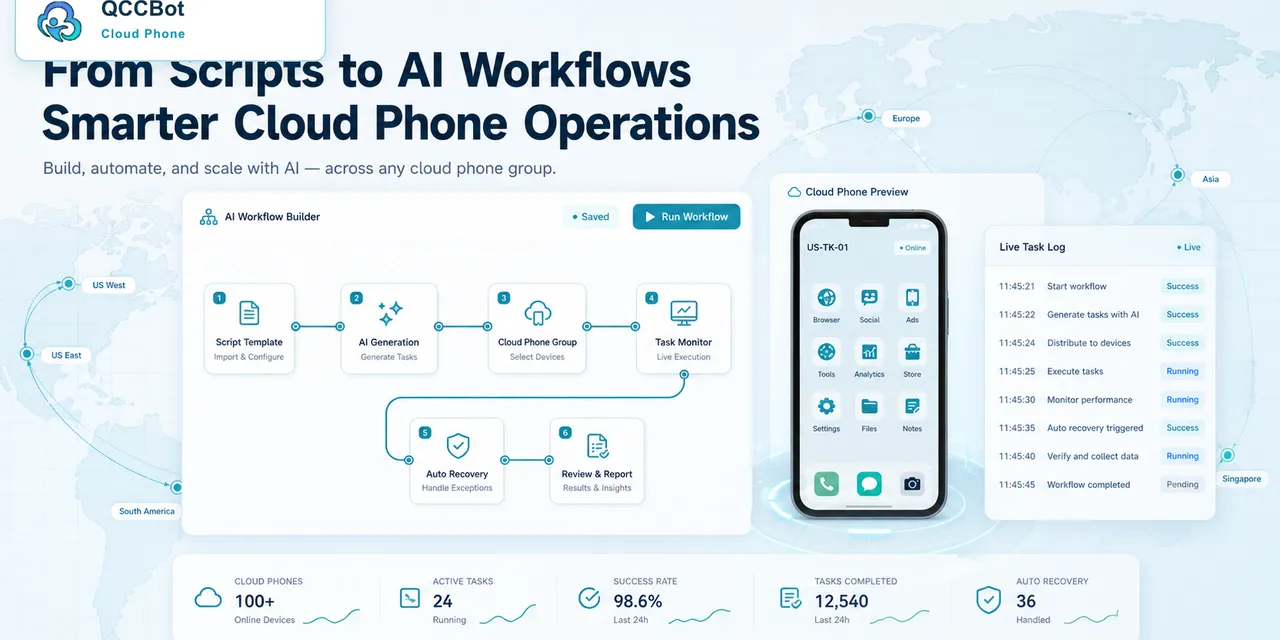
QCCBot lets teams run Android cloud phones, generate AutoJS scripts with xeasy code, debug script errors, and enable AI takeover when scripts fail.
This turns mobile operations into tasks that can be executed, logged, and recovered instead of manually checked.
For teams already exploring AI agents, QCCBot shows how the same automation idea can move into mobile app workflows.
Reference: OpenAI ChatGPT agent help: https://help.openai.com/en/articles/11752874-chatgpt-agen
Questions to ask before choosing a tool
If your team is evaluating tools for AI agents for mobile app work, avoid choosing based only on a polished demo.
Ask practical questions:
- Can we group devices by account, market, project, or task?
- Can we run the same script across a small test group first?
- Can we see task status without opening every phone?
- Can failures be grouped by reason?
- Can AI help debug script errors?
- Can AI recovery be turned on or off?
- Can sensitive issues stay under human control?
These questions reveal whether the tool fits daily operations.
What good content teams and operations teams care about
They care less about abstract automation and more about predictable routines.
A good routine says: this task runs at this time, on this group, with this expected result, and these exceptions are handled in this way.
Once the routine is clear, automation becomes easier to improve. Without that routine, even advanced AI can feel chaotic.
A practical first step
Pick one task that wastes time every week. Run it on three cloud phones. Record every place it gets stuck. Then decide which stuck points are safe to automate and which should be reviewed.
That small test will teach more than a large rollout with no clear measurement.
How QCCBot fits
QCCBot gives teams the pieces to run that test: Android cloud phones, script execution, AI script generation, logs, and exception handling. The goal is to make repeated mobile work easier to operate, not harder to understand.
If this sounds like the kind of mobile work your team deals with, QCCBot can help you test the workflow on cloud phones and decide what should be automated first.
How to turn this into a weekly operating routine
A useful article should leave the reader with a next step, so here is a simple routine teams can use for AI agent mobile workflows.
First, choose one workflow owner. This does not have to be a developer. It can be the person who understands the daily mobile task best. That person should define what normal means, what abnormal means, and which situations are too sensitive for automation.
Second, create a small test group. Three to five cloud phones are enough. Run the workflow there before expanding. The goal of the test is not only to prove that the script can pass. The goal is to discover the common ways it fails.
Third, review the failed runs by category. Do not open every device in random order. Group issues into practical buckets:
- app loading or network delay;
- permission or update popup;
- account logged out;
- UI changed after app update;
- script timing problem;
- human-review case.
Fourth, improve the workflow one category at a time. If half the failures come from a permission popup, solve that first. If the biggest issue is login state, add a pre-check before the main task. This is how thin automation becomes a real operating system.
What a good internal note should include
For every repeated mobile task, keep a short internal note:
- what the task is for;
- which cloud phone group it runs on;
- what success looks like;
- what the most common failures are;
- what AI is allowed to recover;
- what must go to a human;
- where the logs are reviewed.
This note prevents the workflow from living only in one person’s head.
The practical takeaway
The goal is not to make every mobile task fully automatic on day one. The goal is to make the work less blurry. Once the team can see the task state, failure reason, and review queue, automation becomes easier to trust.
That is the type of workflow QCCBot is meant to support: repeated Android app work that needs cloud phones, scripts, AI debugging, logs, and controlled exception handling in one place.